Friday, July 10, 2009

Almost Back in Maine


Well. after more than two weeks on the road, we are in Albany, NY, ready to arrive back in Maine tomorrow for our long summer visit. Our trip north so far has been fairly uneventful, which is good. Being back in the United States, though, has been an adustment, however, from our simple, dusty life in Mexico. Everything is so organized and clean! The roads have such wide shoulders and are so clearly marked. they tell us about the exit coming up starting several miles ahead of the exit. In Mexico, the traffic signs are sometimes blocked by trees and difficult to see. And the notice that we have to exit the highway often appears only a few meters from the actual exit point. People in the US follow the rules very carefully and are not as casual about the rule of law as the Mexicans sometimes are.

Sticker shock is another adjustment we have to make. Prices seem so high here, especially when we have been spoiled not only by the lower prices in Mexico, but have been spoiled by the devaluations of the Mexican peso (now 13.6 pesos to the US dollar) which have made our money go even further. I can see we'll have to watch ourpennies carefully this summer!

We have been having a strange problem with our 2007 RAV4. For about a year, whenever we took a right turn we would hear a loud "thump" coming from the rear of the vehicle. Additionally, for almost the entire trip, we have had a "4WD" warning light onthe dash. In Muncie, Indiana, where we stopped to visit our son Eric and his family, we took the vehicle to the local Toyota dealership (there are Toyota dealerships in Mexico, but the warranty is not honored on a vehicle purchased in the US!). Well they discovered the problem: whenI had the right rear tire replaced in Mexico, they put on a tire the wrong size; about 2 inches short. As a result, when we took a right turn, the axle was sensing that the car needed to engage the all-wheel drive, and tried, unsuccessfully to engage. Thus the thump, and the warning light. New tire, problem solved.
Who knew?

At any rate, we had a lovely visit in Indiana and spending time with our grand daughter, Isabelle, who is now 16 month old. Here are some more photos:


So tomorrow we'll be arriving at our friends' Curt and Judy Webbers house for the next five weeks. They have been to visit us twice at Lake Chapala, and were very generous to offer their house for us to use as a home base while we are in Maine. We will be busy spending time with old friends and family. We will head back to Muncie in the middle of August and be back home in Mexico by the end of August. Maine has been experiencing cold, rainy weather during June and early July. We hope to bring the warm Mexican sun when we arrive!

Monday, June 22, 2009

Trip North


Hola to all of you who check the blog. We will be traveling north to Indiana and Maine for the summer, so I obviously won't be writing about Mexico; at least that's not the plan. We have a young grandaughter, Isabelle, in Muncie, Indiana, the daugher of our son Eric and daughter-in-law, Crystal. We will be arriving to spend about a week over the 4th of July holiday in the now blue state of Indiana. We will then be traveling north, stopping in Erie, PA to briefly visit our friends from Mexico, Fred and Mardele, and their daughter's family, and pick up a couple of small pieces of furniture to bring back to Mexico for them. (Fred and Mardele have lent us their GPS system to use on the trip up; that should be fun to try out). Then we're off to Maine, arriving around July 10. There we'll spend time with our daughters, Wendy and Cassie, my Dad (who turns 89 on Friday) and Stepmom, Joy, and other family and friends. We'll be staying with Curt and Judy Webber, who have appeared on this blog, using their home as a home base. How wonderfully generous of them. They may return to Mexico for their third trip, possibly this fall? We are looking forward to seeing Pixie's siblings and their families and my two brothers and their families. We will spend time with our old friends in Maine, and follow the Red Sox from Red Sox Nation! (They are four games up as I write this morning). We'll stop by Indiana again on our return trip, then be back in Mexico by the end of August.

I may post some family photos and some commentary about our trip, but not as frequently over the summer. I'll return to commentary about our life in Mexico in September. Best wishes to all for a safe and joyous summer. You can still reach us by email, of course. Hasta luego, amigos!

Saturday, June 13, 2009

Colima


Here are our beautiful wives posing at our house this week at our "grub club" Jamaican dinner. We wanted to form a dinner group, but did not want to feel the pressure of calling it a "gourmet dinner group," so we settled on the prosaic title of "Grub Club." Pixie is surrounded here by Jeanne and Susan before we enjoyed our Jerk Chicken and other Jamaican delicacies.

Of course the big event for this week was our brief foray to Colima to celebrate out thirty fifth wedding anniversary. Colima is best known for its two volcanoes, one still active, nearby. Unfortunately, the weather was hot and too hazy to get a good view of the volcano, but here is a file photo of the volcanoes so you can get an idea of how impressive they are:


Colima itself is a fairly large city quite near the Pacific to the beach at nearby Manzanillo, so they don't stop. Colima has been the victim of numerous earthquakes over the years so it doesn't have the beautiful colonial buildings other Mexican cities do, although it was actually one of the earliest cities the Spanish settled. We stayed in the center of town on one of the two central plazas, saw some pre-hispanic archaelogical artifacts, and ate some wonderful Mexican food. We saw almost no gringos in Colima, quite a switch for us. Colima is famous for its Colima dogs, pottery dogs which represented the polular hairless chihuahuas which were popular then, especially as food. The indigenous people made pottery models of these dogs which they buried with people to help their way to the afterlife. Here are some photos of these well-preserved artifacts:


The plaza was beautiful and classically Mexican, surrounded by long buildings on all four sides which included restaurants and shops in the porticos. There was an ongoing chess group which drew lots of curious onlookers. We attended a band concert in the gazebo on Sunday night. You will notice one purple -haired Mexican nina in one of the photos, a rarity here. Here are more photos:


Closer to home, we have had a big event for the past few weeks. Our calle (street), Santa Margarita, has been the street from hell. It was rough and we had to drive very slowly on it to keep from scraping the bottom of the car. Everyone has been complaining about it. The crew came in a few weeks ago and has been doing the backbreaking work of fixiing our road by resetting the cobblestones. They work in the hot sun from 7-6 each day. Here's a photo of them working:

On a walk the other day, Maggie and I ran across this group of goats grazing in the road. Maggie, presumably thinking they were dogs, was anxious to meet them, but the goats were not pleased with her "friendliness."


Sunday, May 31, 2009

News from the Guadalajara Reporter


<

These are three of the workers on the house down the street.  They love having their pictures taken, so I made copies for them and dropped them by last week.  They loved looking at themselves and were busy teasing each other about the way they looked.  You can see in the background that the brick walls have now been covered by cement.  

This is election time in Mexico, with midterm elections scheduled for July 5.  Instead of using lots of paper signs, as in the US, the politicians here paint their campaign advertisements on the sides of buildings, more environmentall-friendly.  Here are two examples:


Both signs are for the presidente (mayor) of the municipality of Chapala, which includes Riberas, the subdivision where we live.  On the left is the sign for the PAN candidate.  The PAN party is the party of President Calderon, now in power.  The sign on the right is for the PRI candidate.  PRI is the party which ruled Mexico for 70 years.  It was considered corrupt and undemocratic.  This 70 year rule ended in 2000 with the election of PAN candidate Vicente Fox.  Surprisingly, the PRD party, the ultra left-wing party which almost won the presidency in 2006, is very weak, at least in this area.  The PAN party is considered conservative and pro-business, and is popular in Jalisco.  

Speaking of painted walls, here's a photo of the beautiful new mural being painted in Chapala on a retaining wall erected to keep the road clear of rock and mud during the rainy season.  Murals are a common type of artistic expression throughout Mexico, in the spirit of famous muralists Rivera and Orasco:


Since there is such a large English-speaking North American presence here at Lake Chapala and, to some degree, in Guadalajara, The Guadalajara Reporter, an English language newspaper reporting news from Western Mexico, including Guadalajara and Lake Chapala, is very popular. To give you a sense of what's news this week, I will detail a few of the main stories from this week's edition. 

1. The headline this week is about the spread of the seasonal dengue fever.  This is an illness in tropical areas spread by mosquitos.  Most dengue fever is temporarily debilitating, but not fatal.  But the hemorrhagic variety is fatal.  The most recent numbers for Jalisco for the year are 131 cases, including 11 cases of the hemorrhagic variety.  Coastal areas have more cases because of their higher heat and humidity, I assume.  The article goes on to describe Jalisco's efforts to use pesticides to reduce mosquito breeding, and warning people, particularly in the rural areas, about protecting themselves from mosquito bites.  We have a friend here who, several years ago suffered a long bout of the non-hemorrhagic dengue.   

2. Another front page story concerned the drug corruption problem.  The federal government swept across the neighboring state of Michoacan last week and arrested 10 mayors and 18 other government officials of aiding a drug cartel, La Familia.  The officials were from all three major political parties, and were intended to demonstrate President Calderon's determination to follow drug corruption wherever it leads, even into his own party.  I think this shows progress, but also demonstrates how serious political corruption is in Mexico.  

3.  Another front-page story is about Chapala's new trash separation program to facilitate recycling.  As of June 1, local residents will need to separate their trash into three categories: organic matter, inorganic matter, and sanitary waste.  The inorganic matter will further be divided into recyclable materials.  The sanitary waste category is necessary because most Mexican households deposit toilet paper and other sanitary waste into trash containers rather than flush it down the toilet.  Recycling has been slow to take hold in Mexico, but there is increasing emphasis here on all types of environmental efforts.  

4. An article inside the paper is about Guadalajara's efforts to design and construct an athlete's village for the 2011 Pan American Games, which it is hosting.  The Pan American Games are like the Olympics, but for the Western Hemisphere.  It is not as well known in the US (although it does send athletes), but it is huge in Latin America.  The village is being built to house 5000 athletes in downtown Guadalajara.  They will begin work by October 5 of this year.  

5. Another interesting piece is about the efforts of eighty-five 10th graders at a school in Guadalajara to spread awareness of the Darfur tragedy.  One student is quoted as saying, "We think the issue of Darfur is more important than Michael Jackson's skin problems."  Sounds like they could provide a few lessons to the American media as well! 

6. Finally, there is an interesting piece about a thermal river spa near Guadalajara.  Thermal river?  Yes, Rio Caliente is fed by thermal springs warmed by underlying volcanic magma.  The article highlights a business started in this rural setting to provide massage and other natural healing services to people who can either stay at the spa or come for the day.  I went to the web site, www.riocaliente.com, and found it interesting but a bit pricey!  

Pixie and I are getting ready to celebrate our 35th wedding anniversary on June 9.  Wow.  Time does fly!  We are going to be taking a two-day trip to Colima, south of here in the State of Colima, and the home a two famous volcanoes, next weekend.  I will post some photos and information about Colima in the next entry.   


Tuesday, May 19, 2009

Another perspective on Mexico

You may remember Linda Elerbee the TV journalist.  She is now spending a lot of her time near here in Puerto Vallarta.  Here is an article she recently published which tells the hidden secret about Mexico.  Enjoy! 


THE TRUTH ABOUT MEXICO…….. 
By Linda Ellerbee 

Sometimes I've been called a maverick because I don't always agree with my colleagues, but then, only dead fish swim with the stream all the time. The stream here is Mexico.  You would have to be living on another planet to avoid hearing how dangerous Mexico has become, and, yes, it's true drug wars have escalated violence in Mexico , causing collateral damage, a phrase I hate. Collateral damage is a cheap way of saying that innocent people, some of them tourists, have been robbed, hurt or killed.

But that's not the whole story. Neither is this. This is my story. I'm a journalist who lives in New York City , but has spent considerable time in Mexico, specifically Puerto Vallarta, for the last four years. I'm inVallarta now. And despite what I'm getting from the U.S. media, the 24-hour news networks in particular, I feel as safe here as I do at home in New York, possibly safer. I walk the streets of my Vallarta neighborhood alone day or night. And I don't live in gated community, or any other All-Gringo neighborhood. I live in Mexico. Among Mexicans. I go where I want (which does not happen to include bars where prostitution and drugs are the basic products), and take no more precautions than I would at home in New York ; which is to say I don't wave money around, I don't act the Ugly American, I do keep my eyes open, I'm aware of my surroundings, and I try not to behave like a fool.

I've not always been successful at that last one. One evening a friend left the house I was renting in Vallarta at that time, and, unbeknownst to me, did not slam the automatically-locking door on her way out. Sure enough, less than an hour later a stranger did come into my house. A burglar?
Robber? Kidnapper? Killer? Drug lord?  No, it was a local police officer, the "beat cop" for our neighborhood, who, on seeing my unlatched door, entered to make sure everything (including me) was okay. He insisted on walking with me around the house, opening closets, looking behind doors and, yes, even under beds, to be certain no one else had wandered in, and that nothing was missing. He was polite, smart and kind, but before he left, he lectured me on having not checked to see that my friend had locked the door behind her. In other words, he told me to use my common sense.

Do bad things happen here? Of course they do. Bad things happen everywhere, but the murder rate here is much lower than, say, New Orleans , and if there are bars on many of the ground floor windows of houses here, well, the same is true where I live, in Greenwich Village , which is considered a swell neighborhood - house prices start at about $4 million (including the bars on the ground floor windows). There are good reasons thousands of people from the United States are moving to Mexico every month, and it's not just the lower cost of living, a hefty tax break and less snow to shovel. Mexico is a beautiful country, a special place. The climate varies, but is plentifully mild, the culture is ancient and revered, the young are loved unconditionally, the old are respected, and I have yet to hear anyone mention Britney Spears, Lindsay Lohan, or Madonna's attempt to adopt a second African child, even though, with such a late start, she cannot possibly begin to keep up with Anglelina Jolie.

And then there are the people. Generalization is risky, but- in general - Mexicans are warm, friendly, generous and welcoming. If you smile at them, they smile back. If you greet a passing stranger on the street, they greet you back. If you try to speak even a little Spanish, they tend to treat you as though you were fluent. Or at least not an idiot. I have had taxi drivers track me down after leaving my wallet or cell phone in their cab. I have had someone run out of a store to catch me because I have overpaid by twenty cents. I have been introduced to and come to love a people who celebrate a day dedicated to the dead as a recognition of the cycles of birth and deathand birth - and the 15th birthday of a girl, an important rite in becoming a woman - with the same joy. Too much of the noise you're hearing about how dangerous it is to come to Mexico is just that - noise. But the media love noise, and too many journalists currently making it don't live here.

Some have never even been here. They just like to be photographed at night, standing near a spotlighted border crossing, pointing across the line to some imaginary country from hell. It looks good on TV. Another thing. The U.S. media tend to lump all of Mexico into one big bad bowl. Talking about drug violence in Mexico without naming a state or city where this is taking place is rather like looking at the horror of Katrina and saying, "Damn. Did you know the U.S. is under water?" or reporting on the shootings at Columbine or the bombing of the Federal building in Oklahoma City by saying that kids all over the U.S. are shooting their classmates and all the grownups are blowing up buildings. The recent rise in violence in Mexico has mostly occurred in a few states, and especially along the border. It is real, but it does not describe an entire country. It would be nice if we could put what's going on in Mexico in perspective, geographically and emotionally.

It would be nice if we could remember that, as has been noted more than once, these drug wars wouldn't be going on if people in the United States didn't want the drugs, or if other people in the United States weren't selling Mexican drug lords the guns. Most of all, it would be nice if more
people in the United States actually came to this part of America ( Mexico is also America , you will recall) to see for themselves what a fine place Mexico really is, and how good a vacation (or a life) here can be. 
 So come on down and get to know your southern neighbors. I think you'll like it here.  Especially the people. 
 

Friday, May 15, 2009

Two Year Observations


It has now been two full years since we retired and moved to Mexico.  Therefore, I thought it might be a good time to reflect on the past two years and write about the TEN THINGS I’VE LEARNED SINCE RETIRING AND MOVING TO MEXICO.  So here is the list:


  1. Contrary to what I had imagined, being retired is wonderful.  Now, keep in mind, I loved my job and was more than a little reluctant to retire.  I was afraid that I would regret the decision soon after I actually retired.  Fortunately, I am very happy to be retired.  BUT, and I think this is a big BUT, I am fairly certain that the decision to move to a new culture and immediately get involved in a number of stimulating activities has made a huge difference.   For example, I was worried about missing teaching.  So I immediately volunteered to teach  English here to Mexicans.  I love the contact with my students.  In addition, I am actively involved with other writers here and am busy in our Unitarian Universalist Fellowship here.  I am learning a new language and happily adapting to a new and exciting culture.  So I am as busy as I want to be.  The hardest thing is being away from our family, but we are making regular trips twice a year back to the US, which does take much of our extra income; but it is worth the extra money, for sure.  I doubt I’d have been as happy retiring and staying in my old life. 


  1. You cannot take your health for granted.  Well, I was very fit, exercised regularly, was relatively young, and I still had some major medical problems this spring.  Go figure?  A brain hemorrhage and a deep vein thrombosis were not exactly on my radar, but both occurred.  So, despite our false feelings of invulnerability, I have learned we cannot, ever, assume that our good health will continue uninterrupted.  It’s simply too complex, and there are environmental threats we don’t even know about.  So, even as I am recovering nicely from my problems of this spring, I will not become complacent about watching my health and taking steps to stay healthy.  An important lesson!


  1. Although medical care is cheaper in Mexico, it takes time and energy to assure we are getting good care.  We are finding, as is probably true anywhere, there is a wide variety of quality in medical care here.  We recently had to change doctors because the doctor we were going to was simply not aggressive enough about treating what turned out to be a potentially serious brain hemorrhage.  We now have a medical team which, although more expensive, seems more professional and is tied into a good group of specialists.  Medical insurance is available here, but at a high price and with high deductibles.  The IMSS coverage, offered by the state, is very economical and usually good.  For example, our next door neighbor, a Canadian, recently had a hip replacement through IMSS, and it went very well.  Although we’ve heard reports that the hospitals are not as clean and overcrowded.  We have chosen to stay with private insurance and are keeping our IMSS just to cover all bases.  But there is no perfect solution.  And, along with travel, medical care takes most of our extra money. 


  1. Although poverty is never desirable, it seems as though the poor in Mexico have an easier time than the poor in Maine.  This is true for several reasons.  First, the climate is so mild that keeping warm is not difficult in Mexico.  In Maine, it takes a significant amount of labor (wood) or money (oil or gas) to stay warm.  Many of my students had to miss class or drop out of school because of high heating costs.  Another advantage of Mexico is the easy and cheap availability of public buses.  Here, most Mexican families cannot afford a car, but they can easily get to work by bus.  The buses run all day and cost about 6 pesos (about 50 cents).  Most are full of Mexicans going to and from work.  In Maine, you need to keep are car which can pass yearly inspections.  This can be prohibitively costly for poor families.  There are also many medical clinics which are very low cost here.  The care is probably not great, but it is available for poor families.  Not so in Maine, where poor familes usually show up in the ER when there is a crisis.   Finally, I think the strong extended family networks work well here.  There is not the ethic of “You’re 18, time to live on your own” here.  Many families live together, often with many people in a few rooms, because there is no other option.  It’s not ideal, but, as a result, there is very little homelessness.

  1. When you choose to move to a new culture, you must accept a some puzzling, sometimes undesirable behaviors.  This is clearly true in Mexico.  Although we love the Mexican people, they are, let’s face it, different than we are.  They tend to tell you what you want to hear,  even if it’s not true (they are not hesitant to give directions even if they have no idea where to go), they will promise you to be there by a certain time, but have no intention of following through, they throw trash on the ground regularly, they love all-night, very loud parties and loud cohetes, or rockets, and I could go on.  As an example, they throw all kinds of waste into the empty lot across from our house.  The other day they burned the field down, without warning, to keep the brush down.  In the process they burned the telephone pole which collapsed into our road overnight.  See photos below.  If you are going to survive and be happy here, you have to let go of the idea that they will ever decide to do things as they do in the US.  It is not going to happen! Those who remain happily here learn this and adapt to it.  A common phrase we here among expats is, “Oh well, it’s Mexico; what are we going to do?” 

    -


  1.  Watch what you eat and drink.  This sounds like a stereotype: “Don’t drink the water!” but it is true.  We need to be careful to drink only purified water here.  Even though we have purified water in our house, we drink bottled water only; it simply tastes better.  We also have to be careful; where we eat.  The Mexican love these outside road food stands.  But often they do not have sanitary conditions to clean with, so we avoid them.  There is plenty of good Mexican food without eating street food.  Many people who do (and some who do not) have been infected with parasites and/or amoebae: not life threatening, but uncomfortable and difficult to treat.  We have avoided these so far by avoiding street food and soaking all our produce in a disinfectant.  Living here has it’s price!  But, of course, the food is wonderful and cheap if we take the precautions.


  1. I’ve already touched on this, but money is an issue.  It’s cheap to live here, and we can easily do it, but if we want to regularly visit our families and stay healthy, we have to devote a significant portion of our income to these.  We usually fly, but this summer, we’ll be driving back to Maine for an extended visit.  That will be expensive too, but worth it.  My medical care for my illnesses this spring have already topped $4000 easily, just for the diagnostic procedures and drugs.  Another friend of ours paid over $10,000 for a hip replacement, less than the US but a large out-of-pocket expense! 

  1. Living in a large expat community is better than I had thought.  I was reluctant to move to Mexico and live with so may gringos, but I was wrong.  The amazing variety of US, Canadians, and Europeans who live here make our lives rich and interesting.  Many have travelled all over the world and have much experience to share.  We have many friends and it’s so easy to meet new friends here.  They share our culture and interests.  On the other hand, it’s not as easy to make strong Mexican friends here; our cultures are just very different! 


  1. Finding reading material in English is much easier than I thought.  Not only does the Lake Chapala Society have a large English-language library, but we share books among friends and many restaurants have free book exchanges as well.  We have had no trouble ordering books from Amazon and having them delivered to our Mexican mailbox, duty-free.  Plus, on our frequent trips to the US, we always bring books back.  We have excellent Internet access here, so some people use Amazon’s Kindle to download books, a bit to pricey for us.  But I regularly read the New York Times and a variety of magazines as well. 


  1. The Mexican people are gregarious, courteous, and fun-loving.  We enjoy being guests in their country.  One interesting thing I have noticed is that there is a much stronger native American influence here than in the US.  Most Mexicans are Mesitzos, part white and part Indian. Most have some of the darker Indian skin.  Some of the wealthier Guadalajarans who visit here on weekends are almost entirely white, but most of the people we deal with are very much darker.  It is my unsubstantiated theory that these Indian blood Mestizos  carry in their genes a tendency to take life as it comes and find happiness despite their poverty.  They seem so happy compared to Americans, even though they may be poor.  Just my theory; but we do enjoy living among them. 


So, just some random observations after being here for two years.  


Thursday, April 30, 2009

Swine Flu in Mexico

As everyone surely knows, Mexico seems to be the epicenter of the infamous swine flu outbreak.  Since family and friends have expressed concern, I thought it would be good to explain what the situation is for us now and what precaustions are being taken here.  

First of all, the vast majority  of cases have been in Mexico City, which is about 8 hours from us by car.  The thinking here is that a large number of people were initially infected before the authorities knew what was going on, so the outbreak had a chance to take hold.  Further, many Mexican people are poor and are not as well nourished as they could be which may have compromised their imune systems.  Many people do not have any kind of health coverage, so they waited until theri symptoms were quite severe before seeing medical attention and had advanced pneumonia when they showed up at the hospital.   So the large number of deaths, relative to the US for example, is still under investigation but these are some theories.  

Our situation in the State of Jalisco is quite different.  President Calderon, in order to do eveything possible has ordered widespread closings to prevent large gatherings in public.  Here at Lakeside, all restaurants are closed, open for take-out only.  Schools are closed.  Many non-essential businesses are closed, along with churches.  Many public events have been cancelled.  All this in spite of the fact that no cases of the swine flu have been confirmed in Jalisco here.  We have all been advised to stay home and wait for the threat to pass, which most of us are content to do.  We just have to wait and see how the situaton develops.  

Mexico, as a poor country is not like the US and has limited supplies of anti-viral drugs and face masks available.  The government is relying, as far as I can see, on trying hard to control the spread of the virus.  Most people seem to support the government, although in Mexico there is always a residual mistrust of the federal government.  Hopefully, this will begin to fizzle out and life can return to something approximating normalcy.  

I promised in the last blog entry to show photos of the completed tile work on our fireplace and coffee table we had done last week.   Here are some photos: 


Finally, I had my last English class last night.  We had a party instead of a regular class. Pixie has been helping me in class, and has decided to teach a class herself next fall.  Only four students showed up for the pizza party, and Pixie snapped this photo of me with these students:


Friday, April 24, 2009

Love in Action

Love in Action is an orphange in Chapala.  Mexico has many orphanages, unlike in the US.  Many are sponsored by brothers and sisters from the Catholic church, not surprisingly.  Many children are put into orphanages because their parents have died or are otherwise unavailable. Sometimes, the parents, or the single mother, cannot care for the children and has to put them into an orphanage where they are will cared for.  The orphanages around this area benefit from the generosity, time, energy and money of the American and Canadian ex-pats who live here. This young fellow is Nohei (5), who, along with his brother, Jose (3), was found living alone in a cave!  Both brothers were brought to a wonderful new orphanage called Love in Action in Chapala.  

When Pixie went north to attend the memorial service for her mother, I stayed with our friends, Fred and Mardele Harland.  They have recently become "Godparents" to a Love in Action boy, Kenny (8).  Being a "Godparent" means that you agree to pay money for the child's education each year and become a part of his or her life by doing things with them as often as possible.  While I was at Fred and Mardele's, they brought Kenny, along with two of his friends, Nohei and Jose, to their house for a swim and botanas (snacks).  Everyone had a wonderful time.  Here are more photos.  The top left is Kenny with a mask.  To his right is Jose.  Below is our friend, Fred, with Kenny, then all three boys playing together:


There are so many needs to be met here in Mexico.  Many families live in abject poverty, often with only the moms to look after the children because the men have all gone to the US to work.  Many homes have no phones, no electricity, no indoor plumbing, and little hope for improvement.  The Love in Action orphanage was located in a small woefully inadequate space.  But due to the expanding size (60 children now) they were given the opportunity to moce to a much larger compound, which they now occupy.  Here are two photos of the new grounds:                                                         


On another subject, we are having some minor tiling done.  Everything in Mexico, it seems, is tiles.  The floors are all tile.  The kitchens and bathrooms are all tiles.  There is tile throughout all buildings, commerical and residential.  There are two main types of tile.  Ceramic tile is the kind we see frequently in the United States.  The tiles are often larger, a foot square or so, and the designs are printed on each tile using some type of standardized manufacturing prosess.  The colors are more muted, even pastel.  The floor in our house, as you can see in the photos below, are ceramic tile.  The other type of tile is very Mexican: Talavera tile.  These are smaller, very colorful tiles usually painted and glazed by hand.  We already have our kitchen done with yellow tile of this type.  Now we are in the process of tiling the front of our fireplace and our coffee table with Talavera tiles.  In the photos below, you can see the tile work being done.  Pixie was not pleased with the fireplace colors, however, despite its clear University of Michigan theme, and we are having it redone in all cobalt blue with the sunflower decorative tiles.  I'll include the finished product in the next blog.  Here are some photos: 


Our friend and contractor, Antonio, is tiling the table himself.  He does not have any other work at the moment, so he is picking up little jobs to do on his own.  

Pixie is back from her trip north to attend her mom's memorial service.  It was a long illness for the entire family, and I think the service, led by our UU friend from Auburn, Kitsie Claxton, helped bring closure for everyone.  The really sad thing about the memorial service came when Corrine's (Pixie's mom) brother, Everard, who was especially close to Corinne and had come up from Massachusetts to attend the service, died in the motel the morning of the service.  One more grief upon all there was already!   Here is a photo of Pixie taken today before she went to her "Red Hat" party! 


I am doing better each day.  I have permssion to drive again, to my great relief.  My  calf with the blood clot is healing slowly, but I am noticing a big difference in the pain this week.  I am exercising it more and following the doctor's instructions.  My energy is coming back, and I am starting to write some poetry again.  I still have no smell, which I address in the following poem:

Losing Smell


It seems to me

I’ve lost my smell

I noticed it one night

While using Ben Gay.

I couldn’t smell

It’s strong minty odor.

“Does this smell?

I asked my wife

Who looked at me

As though I’d lost

More than my smell.


I opened the door

Of the refrigerator.

I couldn’t smell fruit,

The vinegar, the dressing.

So that’s it.

I smell nothing at all.

Some days I test

My nose again

With Ben Gay.

No luck.

What does this mean?


Not all bad.

No septic smells.

No bad farts.

No smells like something died

Across the street.

But then again,

No bakery smells,

No perfume, no bacon,

No coffee, no wet soil.


The doctor thinks

I’ll smell again

When my brain is back

To normal.

[Does he know

My brain has

Never been normal?]

It will

Or it won’t.

I can live with it

Either way,

For I can remember

Those smells,

But it’s not quite the same,

Of course.

I would miss the smell

Of my wet dog. 

Friday, April 10, 2009

Happy Easter


Although I am not a Christian and Easter is not a big day for me, it is a HUGE day in Mexico.  In fact, Semana Santa (Holy Week) is a huge time for vacations, beach trips, and family gatherings. The price of fish, for example, around Lake Chapala doubles during this week to meet the demand.  Children have two weeks off from school, and the Lakeside area becomes overwhelmed, not with gringos, but with Mexicans from Guadalajara who have viewed this area for many years as a weekend retreat for Mexicans.  

Each commuity has their own customs around celebrating Easter. Ajijic has its own tradition which is known throughout Jalisco.  In Ajijic, each Good Friday, a procession goes from the church in the center of town, up onto the mountainside, with characters including Roman soldiers, Christ and two theives, each carrying their own crosses, where the crucifixion is reenacted.  Today they tie Christ onto the cross, but several years ago they would actually nail his palms to the cross.  It is a great honor chosen to be chosen to be Christ, but it used to be a good deal more painful.  At any rate, it is a remarkable ritual for which this town is very proud.  Here are some photos taken from the online magazine Mexico-Connect:


The weather here is getting warmer, especially in the afternoons, and dust is becoming much more noticeable.  Wash you car and an hour or two later, it is covered with a thin layer of "polvo" or dust.  Some people cover their comuters during this time of year.   You often see people, presumably with medical problems, wearing surgical paper masks.  Perhaps partly it is because of the dust.  There is, of course, very low humidity, so the heat is not oppressive.  It cools off by evening and stays cool in the morning.   But it is much warmer in the afternoons than usual.  The temperature may only be 90 degrees F, but because the sun is much more intense so it seems much hotter.   

I have, unfortunately had another experience with the medical system.  Although my mysterious brain bleeding is recovering nicely, and I am having far fewer symptoms and reducing my medications, I was having some sever pains in my calf, so I returned to my (new) physician.  He thought we should rule out a clot so sent me for an ultrasound.  Well, it turns out, I have a deep vein thrombosis in my right calf.  The treatment is complicated by my brain bleeding, which means they can't use anticoagulants, the therapy of choice.  Since the clot is below the knee, though, it is not in a high risk for breaking off and causing a pulmonary thrombisis (clot in the lung) which could be very dangerous.  They are monitoring the clot very closely to see if it changes or grows to become more dangerous.  I can report that it finally seems to be improving and my pain is better.  I have never had problems seeing either my physician or my cardiovascular specialist the same day if I had any concern.  I have had top notch imaging evaluations, including CaT scans, MRI's and doppler ultrasound.  So, hopefully, once this is over, I really will be better.  

The really sad news is that Pixie lost her mom to a long and courageous battle with lung cancer this week.  Pixie had gone to Maine in late January and stayed for five weeks to help her sister care for her mom, but she felt she had to return in Early March and help me with my problems.  It's been a tough winter for Pixie.  Here is a photo of her Mom in 2003 talking with Pixie: 


Pixie will return to Maine for a few days next week to attend the memorial service.  Unfortunately, I cannot fly now because of my medical problems, so Maggie and I will be staying with our friends Fred and Mardele Harland while Pixie is gone.  It's been a difficult time for her entire family, and I wish them the best.  

Sheldon James, a good friend of ours, found this excellent article which accurately discusses the narco-violence problem in Mexico.  I continue to get emails from my friends north of the border who worry about this issue, and imagine us trapped in our house surrounded by bandidos, certainly not the case.  Here is the article.  It's from a blog entitled The Truth About Mexico:

A post by "Frank Koughan" | http://burrohall.blogspot.com

Frank is the author of Burro Hall, and is a former CBS News 60 Minutes producer who has been living in Queretaro since 2006. To see more posts by this author, click here.

As the Iraq War enters its seventh year, I’ve been trying to imagine a world in which CIA director George Tenet, faced with deciding whether to recommend sending young American men and women into a dangerous foreign country, receives information from the State Dept. and, instead of disregarding it, accepts it as credible and recommends standing down from the mission.

As reported by the New York Times this week, this actually did happen. Unfortunately, it happened six years too late; the country was Mexico; the mission, spring break; and the young people at risk were Tenet’s college age son and his friends. And this time, it was State that was being unnecessarily alarmist.

Last month, the State Dept. issued a travel advisory for Mexico that was, by bureaucratic memo standards, rather breathless:

“Mexican drug cartels are engaged in an increasingly violent conflict - both among themselves and with Mexican security services - for control of narcotics trafficking routes along the U.S.-Mexico border…Some recent Mexican army and police confrontations with drug cartels have resembled small-unit combat, with cartels employing automatic weapons and grenades.

Large firefights have taken place in many towns and cities across Mexico but most recently in northern Mexico, including Tijuana, Chihuahua City and Ciudad Juarez. During some of these incidents, U.S. citizens have been trapped and temporarily prevented from leaving the area…The situation in northern Mexico remains fluid; the location and timing of future armed engagements cannot be predicted.”

The phrase “large fire fights” tends to have a cooling effect on the tourism trade, and sure enough, colleges across the US have started warning students against spending spring break in a “war zone.”

I have lived in Querétaro, Mexico, for two-and-a-half years. My city is about 450 miles from the nearest beach, and farther still from the nearest wet t-shirt contest, and so I don’t have any particular interest in persuading a swarm of horny teenagers to come survive for a week on tequila shooters. But America’s young people are being fed a lot of misinformation about their neighbor to the south, so I’m here to set the record straight. For the children.

There is indeed a great deal of senseless, drug-fueled violence happening in Mexico right now: over 5,000 people were killed last year, and this year the body count hit 1,000 in just 51 days. But the vast, vast majority of the dead were either involved in the drug trade themselves, or were part of the forces (Army/ police/ judges/ officials) who are fighting them. If you’re planning to spend spring break either working for a drug cartel or joining the Mexican Army, then by all means you should think twice about coming here.

Consumers of American media could easily get the impression that Mexico is a blood-soaked killing field, when in fact the bulk of the drug violence is happening near the border. (In fact, one way of putting this would be that Mexico is safe as long as you stay far, far away from the US.) If your spring break destination of choice is Juarez, Tijuana or Nuevo Laredo, I would humbly suggest that you’re both a degenerate and insane. You’ve got plenty of underage prostitutes right at home in America, and despite what you may have read there’s no such thing as a “donkey show” here. Tenet is right. Cancel your vacation or I’m giving your name to Interpol.

It’s hard to blame universities for issuing these dire warnings, since they have a responsibility to their students, and the fact of the matter is, Americans do get killed here. But in debating whether or not Mexico is dangerous, they’re asking themselves the wrong question. The issue is, is Mexico dangerous compared to the United States? We’ve been hearing for years how American kids are falling behind in math and statistics, so I’ll try to keep the following simple as I can.

According to the State Dept., 669 Americans died “non-natural deaths” in Mexico in the three years between Jan ‘05 and Dec ‘07, which accounts for 30% of “non-natural” American deaths around the world. Sounds scary, but then Mexico also accounts for 30% of the foreign trips taken by Americans, so what do you expect? Furthermore, we’re talking about 45 million American visits to Mexico, so while 669 deaths are a tragedy, they are not exactly a killing field. Based on these numbers, the survival rate for Americans in Mexico would appear to be 99.9986%

Breaking that State Dept’s numbers down a little further, though, we see that 58 percent (389) of these “non-natural deaths” were from accidents - car, plane, boat or “other.” Eighty-five Americans drowned here in this national full of beach resorts. Fifteen died of drug overdoses and 61 Americans - nine percent of the total - committed suicide! Admittedly, life here can be frustrating sometimes, but any tourist who kills himself here should, in all fairness, not be counted against Mexico total.

The number of Americans who decided Mexico would be a great place to kill themselves is nearly half the number of those who had that decision made for them. According to the State Dept, a grand total of 126 Americans were murdered in Mexico during those three years - just slightly less than the 45,000 killed north of the border during the same period. So while your chances of not dying here may be 99.9986%, your chances of not being murdered here are 99.9997%. Anyone who considers those to be dangerous odds would be advised not to spend spring break in Las Vegas, either.

Recently, the Houston Chronicle took a look at the numbers (covering four years, instead of State’s three) and came to a similar conclusion: that fewer than one-thousandth of one percent of American visitors to Mexico come back to Uncle Sam in a pine box. Actually, the way the Chronicle phrased it was, “Caught in the Chaos: More than 200 U.S. Citizens Killed in Mexico Since ‘04”.

So, y’know, one a week, which makes the country a lot safer than most US cities. But then the Chronicle goes on to note:

“The Chronicle analysis showed some American homicide victims were involved in organized crime. The dead include at least two dozen victims labeled hitmen, drug dealers, human smugglers or gang members, based on published investigators’ accusations. Others were drug users or wanted for crimes in the United States…in at least 70 other cases, U.S. citizens appear to have been killed while in Mexico for innocent reasons: visiting family, taking a vacation, or simply living or working there.”

In other words, of the “200 U.S Citizens Slain,” 130 of them simply didn’t draw their own weapons fast enough. So we’re really talking about seventy murders in four years, during which time Americans made 60 million visits to Mexico, which has a population of about 120 million. For the record, that’s ten percent fewer murders than took place in Houston, population 2 million, in the first three months of 2008:

“HPD officials say that the City of Houston has recorded the fewest numbers of murders for the first quarter of this year since 2005.

“The unofficial numbers show 78 murders were recorded through the first three months of this year.

“There were 88 murders for the same period in 2007. That’s an 11.3 percent decrease.”

In case it’s not clear, Houston officials were proud of this. And they should have been, because in 2007, Houston had the second-highest urban homicide rate in the country:

“In Houston, the number of murders increased to 379 last year from 334 in 2005, a jump officials blamed in part on hurricane evacuees.

“The homicide rate has been much higher in years past, especially the 1980s,’ HPD Capt. Dwayne Ready told the Chronicle in October.

“‘Even if the number … for 2006 hits 400 it’s not a bleak picture for Houston.’”

If 400 people get gunned down in Houston in one year, the Houston Police Dept. doesn’t think it’s a “bleak picture.” But seventy innocent Americans get killed in Mexico over the course of four years, and the former director of Central Intelligence is warning people to steer clear? Where was this sense of caution six years ago?

Mexico is a real country, kids, not some isolated beach resort. There’s crime here. People die here – mostly by accident, but some by murder. But the same is true of the United States. The state of Querétaro, where I live, is very small – a little over a million people – and at any given time there are about 50,000 Queretanos working in the United States. In 2007, forty-one of them were shipped home for burial by the Mexican embassy. Strangely, no one here ever tries to talk me out of returning home for a visit.


Wednesday, March 25, 2009

Getting Back To Normal


Well, after dealing with the medical problems of the past month or so, and realizing that it was potentially more serious than I had originally thought, and with Pixie home to keep her eye on my every move, I am finally feeling as though thing as starting to get back to normal.  I still have a few symptoms with balance and fatigue, but these are nowhere near what they were before.  I go back to the doctor on Monday and will probably schedule another brain scan then to see if they can figure out what was going on and to find out when I can DRIVE again!  In the meantime, I have a wonderful, attentive nurse who cooks wonderful meals.  Of course I miss cooking, shopping, doing laundry, etc., but this is only temporary.  As you can see from the photo above, I am still here and healthy, just walking temporarily with the assistance of a cane.  

The neighborhood where we live is called Riberas del Pilar.  It is between Ajijic and Chapala, and is what I would call a developing neighborhood.  There are many houses here, but also many vacant lots.  Slowly, these lots are being sold and homes are being built.  There is one of these lots right up the street from our house, so I thought it would be interesting to photograph the house in various stages.  The basic structure is there now, so I can show these photos.  But I have to tell you, the Mexicans absolutely adore having their pictures taken.  They love to show off for the camera.  You can see in one they are holding heavy rocks over their heads to show how strong they are.  When I walk Maggie, the always ask if I am going to take another photo. The first photo shows the "jefe" or the boss.  He wanted his picture taken separately.   You can see the progress of the building, totally by hand, which went up to this stage in a ccouple of weeks:  


You can see from these photos that the method of house construction is to dig down about five or six feet to build a stone foundation, then build the walls with brick.  Once the walls are in place, the brick is covered in cement and painted to form an adobe-looking house.  Virtually all the houses here are built this way.  Sometimes contractors try to skimp on the foundation which can lead to major cracks when the house settles.  A friend of ours actually had to move out of her new house when 3-4 inch cracks appeared all through her walls, and she is in the process of trying to sue the contractor to get her money back.  The deep foundations are important to protect against earthquakes.  We purposely bought a house that had been lived in awhile so we could see if there were any problems with the house settling.  I will post more photos of this house as it nears completion.  I'm sure the construction gang won't object!  

The weather is warming up now as we approach the hottest part of the year in April and May before the rainy season begins in June.  We normally take walks down by the lake at a local park, shown in the photos below.  Snowy egrets, like the first photo on the left, are present all year round at Lake Chapala.  They are fairly tame since they are used to people walking in the park, so we can see them up close.  The photo to its right is a portion of the part that we walk in.  As you can see, it's very peaceful and beautiful right next to the lake.  There are always lots of fishermen fishing in the lake, as you can see in the example below.  Interestingly, they always fish with nets.  We see lots of murals and paintings illustrating this practice, so I assume that net fishing has always been the method of chice here.  At least they use outboard motors now.  In the last photo you can the the pelicans, who are only here for the winter months, hoping to get fish scraps from the fisherman. 


As the winter months come to an end, so does the semi-dormant period for plants. During December through mid February, plants tend to become somewhat dormant with fewer blossoms, needing less water, and generally not growing much. I was glad to see this period end, as we welcomed a couple types of Amarillus, generally more blossoms on all plants, and faster growth. Coming from Maine, this really doesn't look too dormant, but it is as close as we get to dormant here.  So I am including photos of our newly discovered Amarillus and newly blossomed Copa del Oro which we are using to create shade on our terrace.  One of the few things I have been still doing is watering the garden, and I enjoy the flowers so much.  I hope you enjoy these images!  


Here is a poem I recently wrote about the joys of watering my garden:

The Watering


Standing amid the green

With my red rubber hose

I use my thumb

To fan the water

To soothe the arid soil

And return my restlessness

To this routine

Of water and earth.


And as I feel the comfort

Of warm sun on my neck

And moisture leaking

Into my shoes,

I watch the soil darken

And I imagine

The connection underground

As the wetness tickles the roots

And we all drink in

The fragrance of wet loam.

Together,

For a moment,

I am this garden.


And now everything

Which has existed

And lived and died

Has emerged at this place

And at this time

To bring me into this

Circle of mud and fragrance,

Into this timeless instant

When my life has emerged

In the water, in the soil,

In the fertile orgasm

Which spawns green and blossom

So perfectly.  And I

Understand, at last

That my perfection stands among

A perfection

I will never understand.


Yet, In this now,

I absorb it all

Through my face

And through my shoes. 


Finally, I thought you might enjoy reading some recent remarks by Janet Nepolitano, Secretary of Homeland Security on the alarming US news media reports about Mexico becoming a failed state, which seems to be a preposterous assertion:  


March 19, 2009 5:12 PM

Napolitano: Mexico Not A Narco-State "At This Point"

Posted by Bob Orr 


Department of Homeland Security Secretary Janet Napolitano says Mexico is “not at this point” in danger of becoming a failed narco-state. But she says the ongoing drug cartel related violence is a threat to both Mexico and the United States. 

Napolitano will be traveling to 
Mexico City April 1-3 to meet with her security counterparts and attend a conference on arms trafficking. Attorney General Eric Holder will also be there. 

Napolitano says the Obama administration is very focused on 
Mexico and is in the process of increasing security efforts along the border. Additional Immigration and Customs Enforcement and Customs and Border Patrol officers are being deployed, and the administration is still working on a broader plan to deal with potential “spillover violence,” though details are not yet available. 

Most of the violence involves “cartel on cartel” fighting. So far, Napolitano says, 
U.S. officials do not see any evidence that cartels are targeting law enforcement or border officials on this side of the border. There has been an increase in the number of kidnappings in the Southwest U.S., but Napolitano says they largely seem to involve drug gangs targeting other drug gangs. 

Meanwhile, 
U.S. officials are bolstering efforts to choke off the flow of weapons heading to Mexico. Various sensors, scales, and license plate readers are being used to identify suspicious vehicles, with some success. For example, 997 firearms were confiscated in one week this month.


Thursday, March 12, 2009

My Illness

About two weeks ago, I had just returned from my weekly trek to the market and was having some lunch and enjoying some down time before I wnt to teach my English class at 3:30.  Pixie was back in Muncie, Indiana, tending her sick mother, and everything seemed normal here. I suddenly developed an rather painful headache and corresponding vertigo when I tried to move much or even look around.  I ended up cancelling my class and relaxing for the next day and a half, hoping to nip this problem in the bid.  

Since I had been talking to Pixie every day, I told her about the symptoms on Thursday morning.  She was understandably concerned and wanted me to visit our doctor, Dr. Leon, that day.  I wanted to see if it would resolve itself overnight, so I agred to go the next morning.   By Friday, it was no better, so I went to visit the doctor.  After examining me, he concluded I had some type of infection, either viral or bacterial, which was manifesting itself in this way.  He gave me some medicine, and asked me to call him in the morning.   The next morning showed little if any improvement,  I was barely functioning.  Simply getting up to cook a meak or answer the door was a major trial.  I mostly lay on the sofa and tried to eat enough and drink enough fluids to stay hydrated and fortified, whichwas difficult because I had no appetite and could keep little down.  He asked that I call again later on Saturday to report my progress: none.  He then suggested I come into the Ajijic Clininc, a small hospital in town, to get some IV nutrition.  

When I got to the hospital ( my neighbor drove me; I was too dizzy to drive) he hooked me up to the IV.  I thought I'd be there for a few hours, so I brought no toiletries, eyeglasses, etc.  Turns out he kep me for two days, till Monday.  Thank God my friend Trudy was kind enough to bring me some lip glass and toohbrush and paste.  It was very tedious, but by  Monday I was beginning to feel better with the medicines and extra fluids. 

Once I got home, I want back to my old medicines, but my progress was very slow, and I still had most of the symptoms.  My friend, Fred's family was visiting.  His son is a physician and dropped by at Fred's request to check me out.  He was of the immediate opinion that I needed a brain scan to find out why I still had a bone-crushing headache.  He got together with my other friends to call Pixie and let her know how worried they were about me too.  They finally hijacked me and took me to another doctor, who ordered a brain scan right away.   Well, three brain scans later, they determined that I had hemorrhaging in my brain, NOT caused by a tumor or aneurism but probably by a bump on the head. (I did remember an egg on the head abour two weeks before these symptoms started).  

The symptoms I was having were most likely caused by  brain swelling as a result of the brain bleed.  I am being treated for the swelling by steroids, dieuretics, rest, and pain meds.  Hopefully, in another week, the swelling symptoms will be gone.  I will need to take anti-convulsive meds (Dytlanin) for about six months, because as the blood is reabsorbed into the brin, it can leave scarring and cause convulsions, so I can't drive for about a month.  Pixie arrived home Sunday and has been taking excellent care of me and feeding me, since I've lost 12 pounds through all this.  

SO... I am on the mend, and glad to be reunited with Pixie.  This experience is humbling for several reasons.  First, I did think, when they read the first scan, that I was looking at a brain tumor!  UGH.  Second, I don't remember hitting my head, but it must have been very hard.   Surely, we cannot take our fragile lives for granted.  

Thanks for all your emails.  I  have been inundated, and I hope this will answer more of your questions.  I have so many who love and care for me.  


Monday, February 23, 2009

Cost of Living (Continued)

I am putting this photo of our pink bouganbilia bush as the first photo on this entry because I am so proud of it.  Our bouganbilia had been healthy but without many blossoms.  Shortly before Pixie left she suggested that our problem might be that they were getting too much water.  Since she's been gone, I've been abandoning my "if a little water is good, more is better" philosophy, especially with the bouganbilia.  You can see the results!  Here are some other photos of the garden as it looks today:


The winter months of December and January are somewhat dormant, but now, in late February, I am seeing that the plants are growing more and blooming.  A big project we've been working on is to plant a vine wall of "copa del oro" in the space on the west side of our terrace to block the setting sun which can make it too hot to sit out on the terrace during the late afternoon.  Our plan is to have the vines block the sun with an attractive wall of plants.  I was hoping to have it ready for the hottest months of April and May, but it looks as though it may take a bit longer:


In my last post, I discussed food shopping.  Today I will explore some other costs of living here, using specific dollar amounts, as estimated from the peso conversion.  Keep in mind that the conversion was 10:1 and is now aobut 14.5:1, so we are getting about 40% more pesos for the dollar.  I don't know how long this will continue, but for now, it give us more buying power.  

The cost of owning a home here is very inexpensive compared to our house in Maine.  This year's property taxes were 950 pesos ($64) and our yearly water bill 2400 pesos ($163).  We have no heating system, and our electric bill, if we keep it under 500 kwh per two month period, we get a cheap rate.  We've converted to fluorescent bulbs, unplug our microwave and TV at night, and generally try to conserve.  We've been doing well.  Our last bill showed a usage of 366 kwh for November and December, so the bill was 547 pesos or ($37).  Our latest telephone bill, which includes calling here in Mexico plus our DSL internet connection (to which our Vonage phone is connected) was 479 pesos ($35.50).  We pay our monthlyVonage bill ($30)  via our credit card which gives us unlimited calling to the United States.  We generally fill our propane tank (dryer, stove, and hot water) once every 2.5-3 months for 1200 pesos ($81).  We change our water filters for the purification system every six weeks at a cost of 360 pesos ($25). So as you can see, the utilities are not expensive.  Of course, those who have bigger houses, with pools, pay a much higher rate for electricity, as much as $250-300USD per month.  

Maintenance on homes is required and usually consists of sealing the roof every 2-3 years, periodic repair of salitrate (a salt decay) on the walls and subsequent repainting.  Labor is not expensive, so maintenance is not a big expense.   We have a maid come about 4 hours, one day a week, and we pay her 200 pesos ($14) plus bus fare (12 pesos).  Our gardener comes for a couple of hours just to weed and cut the grass for 100 pesos ($7).  

Eating out at restaurants is very reasonable.  Breakfast is very cheap, usually costing about 60 pesos for a full breakfast ($4).  Dinner entrees at most restaurants range from 70 pesos ($4.70) to 120 pesos ($8.00). Beer is about $1.5o while wine can be $2.50 a glass, and margaritas are cheap at about $3.00 or less (all in USD).  People tip between 10 and 15%. I like to buy roasted chickens, which are very popular here.  For about 80 pesos ($5.40) you can get a delicious roasted chicken including tortillas, salsa, and roasted potatoes.  Here is where we buy roasted chicken.  It's called the happy chicken, although I doubt that's true! 


Transportation is not expensive.  Most people in Mexico cannot afford cars, and buses are readily available.  I can stand on the main drag, about a block from our house, and take a bus just about anywhere.  It costs 6 pesos to ride into Ajijic or Chapala, and 35 pesos into Guadalajara.  Here is a typical commuter bus.  

Driving is similar in expense to the US.  Gas, which is sold only through Pemex stations, the national oil company, has remained steady at about 72 pesos per litre (about $1.90) per gallon.  There is no self-serve here.  Attendants fill your tank and sometimes wash your windows for a tip.  Here is what all Pemex station look like:


Tires are expensive here, with a large tire for our RAV-4 costing at least $100USD each.  Mechanical work is fairly reasonable, although it costs me about $50USD for an oil change because the 5w20 oil is rare here and needs to be imported from the US.  There is a Toyota dealer in Guadalajara, and I've heard prices are similar to the US.  We have a small problem with the rear end of our Toyota, and I'll wait till we go to the US this summer and get it looked at by a US Toyota dealer, since the warranty is not honored here.  

Here are some other places we frequent: (Clockwise, from top left) the Mexican post office where we get our mail, la pescaderia (seafood store), OXXO (equivalent to a 7-11), and a hardware store.  


In general, you can live on very little or spend a lot here.  Medical care can be expensive, but much cheaper than the US.  The difference here is that we usually pay out of pocket for everything.  Some drugs are generic and cheap, others very expensive.  Pixie had surgery which cost about $2500 total.  We are cancelling our private major medical coverage which costs us $3300 a year (with a $2000USD deductable, per event), but the cost is skyrocketing, and we will rely, for serious problems, on IMSS, the Medical Social Service medical coverage which cost us about $500USD per year and includes everything.  We've heard both good and bad things about IMSS, but it is what we can afford.  Electronic items, like computers, are more expensive here.  And, of course, many items we would have no trouble finding, may not be avaialble here.  (recent examples: magnifying glass,  turkey baster).  We live easily on a modest pension here, and we manage to save money for travel back to the states.  But we have to watch our money carefully sometimes near the end of the month.  We could live cheaper if we had to, and lots of our friends live in more luxurious style.  Many also live on much less.  

Finally, a word about the drug violence in Mexico.  Several of my friends and family members have expressed concern about US media reports of a huge increase in drug violence here.  This is true, but misleading.  There were thousands murdered in Mexico last year, and the trend is continuing this year.  The vast majority are drug reprisal killings against rival drug gangs, police, journalists, and politicians.  President Calderon has declared war on the drug gangs, and the spike in violence is a direct result of his efforts.  Most of the violence is in the three northern Mexico states, but there have been some killings in Jalisco (the state we live in) and in Michoacan (the next state).   I reported a few weeks ago that there was a drug killing in Riberas where we live, but that turned out to be a jealous boyfriend killing.  As far as I know there has been no drug violence in this area.  People here feel safe and secure.  We do not drive much at night, and we take security seriously, as you would in many areas of the US, but we do not feel in any danger.  Living in a foreign country, particularly one with problems like Mexico, is always a risk.  But, to those of us here, at this point at least, the advantages far outweigh the risks.  I suppose it could change.  I think the Mexican people were willing to give Calderon a chance, but many here are alarmed at the increase in violence.  The PRI may take a different tack if they are elected.  The REAL problem, of course, is drug demand in the US.  To me, we may be at the point where we need to look at the problem like we did prohibition and legalize drugs.  I doubt enforcement efforts will ever work when there is so much profit to be made.  We'll see.  But don't worry about us; we're safe.  
 

Thursday, February 12, 2009

Cost of Living


Maggie found a squirrel in our small woodpile and spent the rest of the day trying to dig and root in the woodpile to try to find it.  She ended up with this dirty face.  Just when I think she is starting to have human emotions, I am disabused of the notion by her very "dog" behavior!  

I receved some feedback from people suggesting that the everyday activities were sufficiently interesting for many of you who do not live in Mexico that more detail on this subject is warranted.  So I thought I'd discuss shopping for food, etc. today.  One of the appeals of living here is obviously the cost of living.  I highly doubt we'd have been able to retire at our ages, and not have to work, if we'd stayed in the United States.  Right now, because of the worldwide economic crisis, the Mexican peso has slipped from about 10 pesos to the dollar to about 14.5 pesos to the US dollar.   This obviously helps us, for the time being, but seriously hurts Mexico, a country which is reliant on imports from the US which are now more expensive.  This is triggering inflation here, and I suspect it will continue.  

Shopping for food in the Lake Chapala area offers many choices.  If you want to get the same products you were used to buying in the US, there is Super Lake, a grocery store which specializes in importing goods for the gringos.  We buy a few luxuries there, including good tea, but we usually buy Mexican products for much cheaper:


One good thing about Super Lake is that it is a hangout for Americans and Canadians, and they provide a bulletin board where you can find rentals, items for sale, Spanish lessons, or just about anything else:


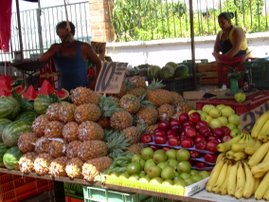
At the other end of the spectrum, we have the weekly outdoor market, or Tianguis (Monday in Chapala, Wednesday in Ajijic, and Thursday in Jocotepec) which features just about everything from produce, to street food, to medicinal herbs, fresh yogurt, flowers, pirated films, clothing, crafts, bread, fish, meat, plants, electronic parts, and much more.  We always buy our produce, yogurt, honey, flowers, and movies at the tianguis.  We have our favorite vendors, of course, who treat us well.  Here are some photos: 


We also have the opportunity to shop at large department-style stores, Wal Mart or Soriana, which are very Mexican and do not cater to foreigners.  So what you might normally think you'd easily find at Wal Mart in the US, you will not likely find at this one.  I do not prefer shopping at these stores.  

Neighborhoods all have small stores, or tiendas, which sell Abarrotes, which means supplies.  Here you can buy one egg, or one cigarette, or beer, or produce, soap, etc.  They are like mom and pop stores, and the family generally lives in the back.  I frequent the one about a block from our house, where I generally buy milk, charcoal, eggs, soap, bottled water, and other household goods.  Here's a photo: 


Now, how much do things cost?  Here is a list of some sample prices.  I have converted them to pounds (from kilos) and to dollars (from pesos):  

Milk  $1.50 2 liters
Eggs  $1.20 / doz
Yogurt $1.40/liter
Chicken (whole) $.90/ lb. 
Pork Chops $1.80/ lb
Steak, tenderloin $3.50/ lb
Tomatoes $.25/ lb
Bananas  $ .10/lb
Avacados $ 1.05/ lb. 
Carrots $ .30/lb
Limes $.50/lb
Oranges $.25/lb
Strawberries (now, in season) $.45/lb
Fresh corn tortillas $.30/ lb
Beans (precooked) $.40/ lb
Sugar $.60/lb
Dish soap (Mexican brand) $.25
Dish Soap (US brand) $1.50
Charcoal (small bag, enough for four grillings) $1.50
Tea (Mexican, not good) $1.20/80 bags
Coffee (Veracruz, from street vendor) $1.35/ lb 
Good British tea ($4.00/ 80 bags...but worth it!)
Tequila...ranges from $3.00-$120 per liter.  Good, aged reposado is about $14
Wine...Chilean table wine $3.50-7.00
Beer...Corona 6-pack $3.50
Dog food (Pedigree) 5lb bag..$2.20
Beggin strips, Maggie's favorite treat (imported) $4.00


Pixie is still in the US with her family.  Maggie and I are eating very cheaply.  

Next time I will continue to discuss other aspects of the cost of living here.  In the meantime, Happy Valentine's Day!  In Mexico this day is called Dia de Amor y Amistad, Day of Love and Friendship, a bit more broad-based.   

Saturday, January 31, 2009

The Truth About Mexico

Here is our friend Teo, the only Mexican member of our Unitarian Universalist Fellowship.  He is the weaver who makes beautiful tapetas, or tapestries, which I have highlighted on this blog before.  He is a very sweet, gentle and kind man who represents, to me, what I love most about Mexico: its people.  Teo lived and worked as an agricultural worker in California for many years, traveling back and forth between Ajijic and California each year.  The work was back breaking and sometimes humiliating.  Once he found his life partner, Janice Kimball, an expat artist from Detroit, she convinced Teo that he could make a living with his amazing weavings.  They now live in Ajijic and own a joint Aztec Studio, where Janice sells her paintings, they sell tapetas designed by Janice and made by Teo, and now Teo's son, Francisco, also makes more modern tapetas which he sells as well.  They are a beautiful family making their living with their art and add so much to this Mexican-Gringo community.  This photo of Teo was taken a couple of weeks ago when Pixie and I hosted a pot luck lunch for our Fellowship in our back yard.  

Pixie left for Maine yesterday and arrived safely in Gray, Maine at the home of her sister, Liana.  She reports that she had to pay $8.00 for a lousy sandwich on Delta Airlines and arrived to mucho snow in Maine, but moderate temperatures in the 30's.  She will be in Maine for an indeterminite period, and I will be fending for myself for awhile.   

The title of this entry came from my reaction to some very bad publicity Mexico has been receiving the last few weeks, which I believe is unwarranted.  The LA Times 
reported a week or two ago that Drug Czar Barry McAfferty, among others, has warned that Mexico may become a failed state, similar to Afghanistan and Pakistan.  This analyis is based on three trends.  The Narco Gangs are proliferating, especially in the northern Mexican states near the US border, and over 5000 people were murdered last year in drug-related violence.  Although President Calderon hascommited Mexican troops  and federal police to fight this problem, these efforts seem to be increasing the violence.  Second, the oil reserves owned here by Pemex, the national oil company, are diminishing which, combined with lower oil prices, will decrease revenue substantially for Mexico in the next decade.  Finally, the economic recession in the US is drastically dimishing remittances from the US, a significant source of Mexican income.  All this is true.  Nevertheless, Mexico remains a vibrant democracy which demonstrated in 2006 that it could handle a close presidential election without violence.  I see evidence of government efforts to fight corruption and rebuild Mexico's infrastructure every day.  I am now able to read, with reasonable accuracy, Mexican newspapers which report political and cultural events regularly.  Mexico has problems; there is violence; and the future will be economically challenging.  Nevertheless, those of us who are living here by choice, as foreign nationals feel safe and secure here.  The US certainly struggles with violence and economic insecurity as well.  But in this culture, where people are used to surviving, despite long odds, there is an expectation that they will survive this too.  The peso is falling (as of today, 14.2 pesos to the dollar down from about 10.00), trade with the US is diminishing, and NAFTA continues to raise  the prices of tortillas and other corn and bean products here.  But the people are resiliant.    The less you have, the less problem is caused by an economic downturn.  

I received an email from one of the readers of this blog about a comment I made suggesting that I feel as though I may be running out of things to write about.  He suggested that I should continue to write about what it's like to simply live here, even something as simple as a trip to the grocery store, which, he said, would be interesting to him, because he does not live here.    Well, it may be a bit repetitive, but I will try to follow his advice.  So, in coming posts, I will revisit things like prices, availability of products, and healthcare here in Jalisco.  I just read in the local newspaper that Jalisco has the most number of scorpion stings in all of Mexico; the good news is I have yet to become a statistic!

We have sent for our South Dakota license plates.  Why, you may ask, did I do such a thing?  Because...our Maine plates have long ago expired.  We cannot register our car here becuase we did not buy it here.  (Don't ask, I do not know why.)  The only state which, apparently, will grant auto registration to non-residents is South Dakota.  (When we first got here I was astounded at how many people had migrated here from South Dakota,of all places!)   So, since we are planning a road trip back to Maine next summer, we have sent for our SD plates.  The total cost: only $63 USD.  Beats Maine!  So soon we'll be sporting Mount Rushmore on our car.  

I've been invited over for dinner tonight by our next door neighbors from Montreal, Ron and Pat. They are great friends and the best neighbors.  They have a key to our house and keep an eye on things when we are gone.  Ron taught me how to spray for scorpions and chlorinate the ajibe (undergrouond water tank).  Here's a photo of Ron and his dog, and Maggie's friend, Layla: 


I'll end this post with a photo I recently took of a marvelous mural painted of the goddess of the lake byJesus Lopez Vega, a local artist, at the Ajijic Cultural Center:


Friday, January 16, 2009

Taking the Bad with the Good

(Photo by our friend, Carol Bowman)

As I write this, Pixie is preparing to return to Maine at the end of January to be with her mother who is ill.  She will be staying with her sister in Gray.  We don't know how long she'll be there, but I will be staying in Mexico.  Not ideal, but as Pixie says, "You gotta do what you gotta do."

I lost a friend on New Year's Eve.  His name was Terry Hogan.  He was an interesting man who I met in the Ajijic Writers' Group.  He was Irish. He's been a fisherman, a woodsman, a car mechanic, and he lived on a Greek Island for awhile.  He lived around the other side of the lake and loved Mexico.  He was very kind and encouraged me with my poetry. We gathered in Jocotepec for a celebration of his life last week, and I was able to learn more about the rich life he had led.  It was sad, but I was glad to have known him.  I wrote a poem about the fact that I am meeting interesting people here, but towards the end of their lives.  I find myself wondering what they were like when they were younger.  Here it is:

Meeting You at Twilight  


I am glad to have come across you

Even as the sun sets over the western shore

For you are a beacon to light my way

As I head into my dusk.


Where I feel unsure, you step deliberately

Where I am new, you show me your scars.

You are not like those I do not want to become

Who die slowly every day.

You live in the sun and bask in the heat.


How did you get to this twilight today?

What were you like at noon?

I can only guess.

Were you always walking in front?

Were you like me?

What have you lost in the dark afternoon?


Would that I could walk with you

For just one day in the sun

To look into your face

To see what you feared

And see what you loved

When the sun cast no shadows

On your fresh life.


For now I do not have

Long hours to walk with you,

I know as the sun drops over the trees

That darkness will descend

For you, and for me,

And I am glad to have

Seen you smile and heard your voice

In the evening light. 

We visited a friend's home last week, and she has decorated it with beautiful Mexican art.  I thought I'd post some photos.  Her name is Bebe.  She is from California, has liv ed in Mexico for almost 20 years, and has become a Mexican citizen.  She poses below with her life-sized Katrna: 


Here are some photos I took around her very Mexican home:


Lakeside is more crowded these days as the snowbirds have arrived, mostly from Canada, to escape the cold and snow.  Walmart is open and busy, new businesses are opening, and the peso is still weak against the American dollar.  The drug wars, which are mostly up around the border, touched lakeside last week when a couple of young Mexican men were shot and killed on the Carreterra, the main road through all the north shore towns, a couple of blocks from our house, in the middle of the night, a likely drug-related execution.  But, of course, this kind of thing happens all the time in American cities.  But, sadly, it can happen here too.  

We are all awaiting the historic inauguration of Barack Obama on Tuesday.  Mexicans and Canadians alike are intrigued at the prospect of this new kind of American president.  I'll end this entry with a poem I wrote about Obama which appears in this month's Ojo del Lago:

Barack

(Upon Your Election, November 2008)

Barack

You have reached

Deep into the

Unspeakable shame

Of a people

And pulled out the strands

Which transcend hate.

And now you stand

Above the raw wound

Grasping the fragile tissue

Of redemption.


And we are waiting.

We can see,

Like Plato’s shadows

Insubstantial fragments

Of truth

On which we reflect

Our hopes

Cast unfairly onto you,

So beautiful

And wise

Beyond your years,

So it’s easy

To think we see

A great man

Emerging

Before

Our jaded eyes.


Barack,

As you once stood

And wept

Over your black

Father’s grave,

You now stand

Over a land

Cast in many colors

Which has lost its way

Amid the glut

Of excess

And loud cries

Of tribal hate.


Barack,

Will you help us

Save modernity

From itself?

Can we live up

To the hope

Of your black brothers

And white sisters

Who want

To see

Abraham and Franklin

In your

Honey brown face?


Barack,

Can you help us

See ourselves anew,

Not as God’s children

Chosen to rule

The earth,

But as citizens

Of the world

Who can think

And reason

And love

And share

And survive

Ourselves?


Barack,

I do not know

Your destiny

Nor ours.

But your kind eyes

Reflect the hopes

We have

For the children

Who will inherit

What we

Have wrought. 


Wednesday, December 31, 2008

Feliz Año Nuevo!


We have returned from the chilly north with New Year's Greetings from our beautiful grandaughter, Isabelle!  Who could resist this face?   Here's another delightful image of her I took while we waited for our daughter, Wendy, to arrive at the Indianapolis Airport.  


As you can probably tell, I spent most of the time in Indiana taking pictures of Isabelle.  She spoke her first words while we were there ("Dada" to Eric's delight), and she seems, at nine months, to be on the verge of sprouting teeth and trying to walk.  We enjoyed doting on her, but we also had a family reunion of sorts, with Wendy and Cassie joining us for Christmas.  We also had the privelege of becoming reacclimated to the cold; wind chills were measuring -15F for the firstr day or so after we arrived.  As I sit typing this on the terrace back in Mexico, it doesn't seem so bad.  What we lacked in warm days we made up for with lots of warm memories.  Here is a photo of the kids with us (except Crystal, in this photo):

Eric and Crystal, like us, are diehard Unitarian Universalists.  UU's have a tradition of celebrating Christmas with very ecumenical services, sometimes a bit irreverent.  Theirs was no exception. As parents of a new baby, they were chosen to play the Holy Family in the pagent.  I never pictured Eric as the Joseph type, but he looked the part: 


Here are a few more photos of our Indiana visit, posted especially for Dad and Joy, including one of my soon-to-be 91 year old Aunt Alice, her son Rod, and Eric with Isabelle:


So now we're home in Mexico, and life is returning to normal. We are celebrating New Years with a quiet dinner with friends, and looking forward to 2009 with anticipation. We were at the Tianguis (market) this morning and noticed how the Lakeside area is much more crowded now. The snowbirds have arrived in force. The traffic is much slower, and we see many unfamiliar faces.

Our favorite vegetable and fruit vendors, Carmen and Aaron were glad to see us, and we found good looking mandarinas (tangerines), piňas(pineapples), and peras (pears) this week. Pixie found some three foot sparklers to shoot off, and uvas (grapes) for tonight. The Mexican custom is to eat 12 grapes at midnight for good luck. The other interesting custom is to wear red underwear on New Year's Eve for good luck. I don't know about Pixie but I'm wearing mine!

I have enrolled in a new advanced conversational Spanish class which starts at the end of the month. Pixie has found a teacher she loves from El Salvador who is teaching an introductory course at her home. She has been in this class for a couple of months and she is using Spanish more and is no longer as intimidated by learning a new language. We are able to practice everyday. I noticed on the plane that I could understand the Spanish announcements better than I used to. Poco a poco!

To all the loyal readers of Maine To Mexico, feliz año nuevo (happy new year)!

Sunday, December 7, 2008

Feliz Navidad!


The holiday rush is in full swing in Mexico, as everyone is rushing around Christmas shopping, attending traditional Posadas and Christmas parties, and making travel plans to join their families for the holidays.  Above is our beautiful, pointsettia which has bloomed in time for the season.  We have been fighting some type of fungus on it, as you can see, but it is still representative of the large pointsettias trees which grow prolifically here.   

I have a few photos to share of the St. Andreas fiesta in Ajijic.  It lasts for 10 days or so every November in honor of Ajijics patron saint: Andrew.  Virtually the entire town shows up for the evening festivities.  Here are some evening shots of the plaza during the celebration:


Fireworks are a big part of the celbration, which are difficult to photograph, but I have included these two which consisted of a movable display.  Here is an angel which moved among the crowd, spewing sparks:


Below is a very lucky kid who was selected, at random, to wear the fire-spewing shark and run through the crowd for a once-in-a-lifetime experience:


Last night we invited our friends Carol and Ernie over for dinner.  Carol is fellow member of the Ajijic Writers' Group and administers the English language instruction program which offers free English instruction to over 300 Mexicans this year.  This is the program which provides the class that I teach, which I have written about before.  She does a wonderful job keeping a bunch of eccentric gringos in line, more or less.  And Ernie....well, just look at him!  He's an interesting character; you can tell this just by looking at the twinkle in his eye! 


We will be leaving to visit our son Eric, his wife Crystal, and grandaughter, Isabelle, in Muncie, Indiana next week.  Our daughters Wendy and Cassie will be joining us, so we'll have the entire family together for Christmas.  This will be the last blog entry until after we return December 29.  

Feliz Navitas a toto nuestros amigos y nuestra familia!  


Friday, November 28, 2008

The Big Birthday Bash


Pixie turned 60 on November 10, and our friend Susan Barr turned 65 on November 19, so Steve Barr and I combined forces and put on a big birthday bash at our house on November 20.  Our house is very well set up for a large party, with a big common space inside, and a big yard off the terrace.  We rented some tables and chairs, hired a popular caterer who very reasonably provides a Mexican buffet with handmade tortillas and a large variety of Mexican dishes to fill them, hired our friend Billy to serve margaritas, beer and soda, and a Mexican guitar trio to serenade the group.  We had about 15 of our Mexican friends as well as many of our friends, most from our fellowship.  We had a Winnie the Pooh pinata for the kids which was, of course, a highlight for them.  Pixie and Susan were feted with toasts, gifts, and two traditional Mexican tres leches (three milks) birthday cakes.  There's really not much to say about it, so I just included these photos.  Thanks to our friends Kathy and Kelley who contributed some of these photos.  


We gathered with many of our friends from the fellowship, as usual, at Lew and Trudy Crippen's house in Ajijic to celebrate Thanksgiving.  It was a pot luck affair, and Pixie brought traditional homamade cranberry sauce to add to the wide variety of  dishes, not exactly a New England thanksgiving, but full of friendship and gratitude for our health, family, friendship, and prosperity. 

We have made a BIG decision and decided to return north for July and August next summer.  We will be, of course, stopping at Muncie to visit Isabelle, Eric and Crystal, but most of the time we will be staying at Curt and Judy Webber's house in Auburn.  This will give us a good chance for good visits with friends and family, and will still allow us to get our visas renewed in June and our Mexican health insurance renewed in September.  I will also be able to continue teaching English here, because the program does not continue during the summer. 

We will be going to Muncie for Christmas this year, from December 19-29, so I will be able to post new photos of Isabelle when we return.  Not much else to write about now.  The weather which has been quite cool (down to the high 40's), has turned milder.  We are both well and grateful that our children are all doing well.  We look forward to seeing them all in Muncie.  Here's a photo of us getting ready to celebrate Thanksgiving yesterday.  Notice Pixie's wild colors! 


Monday, November 17, 2008

Rincon De Guayabitos


We returned from our first trip to the Pacific coast since our arrival in Mexico.  Pictured above is the beach town of Rincon de Guayabitos (corner of the small guavas) located about 40 miles north of Puerto Vallarta.  I had never been to a tropical beach before.  We were used to Maine beaches and the ankle-numbing water temperatures.  November seems to be a popular time for people here to make the five plus hour drive to the coast because the climate has cooled from the summer heat and humidity and the high season has not yet begun.  We went with our friends Steve and Sue and Jeanne and Paul.  Here we pose on the terrace restaurant of our hotel.  
The drive down was fairly easy; a high speed "cuota," or toll road, took us most of the way from Guadalajara.  I knew we were getting near the coast when I could see banana and coconut groves, and tall palms everywhere.  We had arranged to stay at a largely Mexican resort, in fact we were, for most of the stay, the only gringos there.  The hotel is very reasonable, about $350 USD for four days with all meals and drinks included.  It was about half full of middle class Mexican families on vacation.  It was quiet at night, and the food was very Mexican and very good.
  
The beach  experience was somewhat different.  first of all, the water was about 80 degrees, very different from our "normal" ocean experience.  The waves are gentle at this beach and the water shallow.  We could sit under the shade of the palapas, shown in this photo.  We did lots of reading and relaxing.  We walked up to the fancy end of the beach and saw where most of the gringos stayed, in a fancy resort of the west end of the beach, not our style.  
We took a drive to some other beach towns north of Puerto Vallarta, and I could see that the close one gets to PV, the more fancy and expensive everything is.  

We also saw some wildlife on beach.  There were many exotic birds.  I really found the graceful frigates beautiful,  but my favorite were the pelicans:


On our last afternoon, Steve arranged a boat ride to the big island off the shore.  I chose to stay back, not wanting to risk my chronic problem with sea sickness.  But the rest of the gang went and, unexpectedly, had a chance to view a couple of whales.  Pixie photographed the one below:


Pixie is a BIG FAN of the beach.  In Maine she would endure the cold, wind and horseflies to "enjoy" a day in the sun.  Here she discovered how wonderful a tropical beach can be.  We will be making this a regular destination, I can see.  

Since returning, Steve and I are busy making preparations for the big birthday bash for Pixie and Susan Barr.  Pixie turned 60 on November 10, and Susan turns 65 on the 19th.  We are hosting a party at our house for 50-60 friends, with a Mexican buffet and a guitar trio.  I'll be sure to include photos in the next entry.  

I'll end this entry with a new poem I wrote after attending the Day of the Dead festivities in Chapala, about looking at the photo on one of the altars.  


Your Sepia Face

 Your sepia face stares soberly at me

From another day, distant from this evening,

Adorned with marigold blossoms

And relics of your time among us,

Which proves to me that you were here

And lived to taste the sour fruits of life

And cried sweet tears for love of those

Who remain, remembering your presence here.


And as I gaze at your framed, faded image

On your vibrant altar, fragrant with breath,

I imagine my family, now long gone

Who live largely forgotten, no color enveloping

Their likenesses with warm, living flowers,

Photographs which remain, unexamined, vaguely recalled,

In a dark box waiting for those who knew them

To pass into the obscurity of memory themselves,

Rendering them forever unremembered.


You are lucky to remain among the breathing

A bit longer, perhaps to remind us all

To look into your sepia face

Reflecting our humble fate.  

Saturday, November 8, 2008

Curt and Judy Webber Return to Mexico for Dia de Los Muertos!


Curt and Judy Webber, from Auburn, Maine, were our first visitors when we moved to Mexico in 2007. They enjoyed everything about Mexico and decided to return here this year for the Day of the Dead celebration. Last year, Pixie had a broken foot and could not get around very well. Well, this year we discovered another element of the celebration. I knew that the people decorated the graves and gathered there to eat, drink, and celebrate through the night. What I didn't know about was the tradition of creating public altars to honor their dead as well. One street in Chapala is set aside each year for these public altars. The altar usually has a photo of the dead relative, along with marigolds, which is supposed to make the passage easier for the dead person to revisit the living. The altar often has things the person enjoyed in life, like tequila, beer, special foods, or items which represent the activities of the dead, like guitars, saddles, or needlework. Some altars also feature a wash basin and mirror, so the dead person can "freshen up" when he or she returns for a visit. They are very creative; some are quite elaborate. Here are some examples:


Many young people here are not as into the sacred tradition of Day of the Dead as their elders are. My students told me they think it is a little over the top. But that does not prevent them from using the occasion to dress up, as Americans do on Halloween, and I saw lots of them celebrating with costumes and music within the altars:

On the right is Maria Elena, our maid, posing with a young reveler. Maria Elena built an elaborate altar with yellow crosses, pictured below. When we stopped by she showed us all the details and gave us fresh pineapple tamales to take with us.


We celebrated the Day of the Dead at our UU fellowship, where we remembered our relatives who had died. Pictured below are Curt and Judy at the service and the altar we used:
A few other bits: Pixie and I returned to Guadalajara Thursday to have our drivers licenses upgraded to four-year licenses, hassle-free with Fernando again. Tonight we are headed into the Degollado Theatre in Guadalajara to see the ballet. This theatre is a beautiful neo-classical building modeled after the La Scala opera theatre in Milan. This will be the first show we've seen there, and it is Pixie's birthday gift. I'm not so reluctant to drive into Guad. these days, as long as I know where we're going. Since the theatre is in the old historic district, I do know how to get there.

And finally....of course...the

Big News we are all celebrating this week: